

Texas is the state that makes cross-country RVers recalculate. You cross the Sabine River feeling good about your progress, and then you find out the El Paso exit is still a long way off. If you’re driving across Texas in an RV this winter, maybe on a Florida to Arizona snowbird run or a holiday trip to family out west, the route you pick and how you split the days will shape the whole week.
Here’s how the two main east to west routes compare, how many days to plan, and when it actually makes sense to come through Waco (and when it doesn’t).
Key takeaways
- I-10 crosses Texas in about 880 miles, from Orange to El Paso. I-20 covers about 640 miles before it merges into I-10 east of Kent, which leaves you a little under 200 more miles to El Paso.
- Most RVers need three to four driving days to cross the state, and five is more comfortable if you want to arrive rested.
- I-10 means Houston and San Antonio traffic but milder winter weather. I-20 means the Dallas and Fort Worth area and more exposure to winter ice and West Texas wind.
- Waco isn’t on either route. It fits when you’re cutting between them on I-35 or US 84, or when you want a real break in the middle of the state.
How many days does it take to drive across Texas in an RV?
Plan on three to four driving days for a straight crossing, and five if you want to stop driving by mid-afternoon each day. That’s the honest answer for most motorhomes and travel trailers.
A lot of RVers follow some version of the “2-2-2” rule: drive about 200 miles, arrive by 2 p.m., stay 2 nights. Very few people crossing Texas stick to it strictly. Interstate days out west tend to run 250 to 300 miles because the road is open and there isn’t much to stop for. The days that wear you down are the ones that combine a big city with a long haul, like pushing from Beaumont through Houston and on to San Antonio in one shot.
If you’re on a schedule for the holidays, build in one spare day. A cold front, a wind advisory or a closed lane in Houston can easily cost you an afternoon.
I-10 vs I-20: which way across Texas?
Short answer: I-10 is the default for the southern half of the country and for winter trips, and I-20 makes more sense if you’re coming from Atlanta, Birmingham, Jackson or Shreveport. Here’s how they compare.
| I-10 | I-20 | |
|---|---|---|
| Where it enters Texas | Orange, from Lake Charles, Louisiana | Waskom, from Shreveport, Louisiana |
| Big cities on the way | Beaumont, Houston, San Antonio, El Paso | Tyler area, Dallas, Fort Worth, Abilene, Midland, Odessa |
| Texas miles to El Paso | About 880 | About 640 on I-20, plus a little under 200 on I-10 |
| Hardest traffic | Houston, then San Antonio | Dallas and Fort Worth |
| Winter weather | Usually milder, especially east of San Antonio | More prone to ice from North Texas west |
| Long empty stretches | Yes, from the Hill Country west to El Paso | West of Abilene, then the same I-10 stretch to El Paso |
Mileage figures are approximate and measured border to border. Your actual trip depends on where you get on and off.
What to know about I-10
Houston is the part most RVers dread. The interstate is wide, but traffic is heavy most of the day and the interchanges come fast. Try to pass through midday on a weekday, or early on a Sunday, and avoid the morning and evening rush.
West of San Antonio, the drive changes completely. You climb into the Hill Country past Kerrville and Junction, then the land opens up and towns get farther apart: Sonora, Ozona, Fort Stockton, Van Horn. Fuel up when you’re near half a tank instead of hoping the next exit has diesel.
Two things surprise first-timers. El Paso and the county just east of it run on Mountain time, so you gain an hour heading west. And eastbound travelers leaving El Paso pass a Border Patrol checkpoint near Sierra Blanca, so have your ID handy.
What to know about I-20
I-20 is the shorter path if you’re coming from the Deep South, and East Texas is an easy, green drive. Then comes the Dallas and Fort Worth area, which is the I-20 version of Houston. The loop south of Dallas keeps you out of downtown, but plan around rush hour all the same.
West of Fort Worth, past Weatherford and Abilene, the country flattens out and the wind picks up. A tall fifth wheel or a high-sided motorhome feels every gust on that stretch. I-20 ends by merging into I-10 east of the little town of Kent, and from there it’s I-10 the rest of the way to El Paso.
In winter, I-20 is the route more likely to get iced over. When a hard freeze hits North Texas, bridges and overpasses between Dallas and Abilene can turn slick fast. If the forecast shows freezing rain on your travel day, that’s a good day to stay put.
Where does Waco fit on a cross-Texas trip?
Waco sits on I-35 between Dallas and Austin, about 95 miles south of Dallas. That puts us roughly halfway between I-20 and I-10, not on either one. We’d rather tell you that up front than have you add a half day of driving to stay with us.
Here’s when a Waco stop makes sense:
- You’re switching from I-20 to I-10. Some travelers come in from Arkansas or Tennessee on I-30 or I-20 to Dallas, then want the southern route west through the Hill Country. I-35 south through Waco, Austin and San Antonio is the connector, and Waco breaks that leg in a sensible spot.
- You want to skip Fort Worth and Dallas. US 84 runs between Abilene and Waco through Gatesville, Brownwood and Coleman, about 200 miles. It isn’t an interstate, so expect small-town speed zones, but some RVers heading to or from Central Texas prefer it to the Metroplex.
- You’re heading south. If your trip turns toward Austin, San Antonio or the Rio Grande Valley, you’re coming down I-35 anyway. Our guide to the I-35 drive south for snowbirds covers that route, including the construction through Waco.
- You need a real day off. On a four or five day crossing, a two-night stop in the middle of the state is worth a lot. More on that below.
If your plan is Florida to California straight down I-10, keep going. Houston and San Antonio are each roughly 180 to 185 miles south and southeast of us, and that detour only makes sense if you want to see Waco itself.
A sample four-day plan across Texas
Here’s one way to split each route. These are rough legs, not rules, and they assume you’d rather not drive after dark.
| Day | I-10 (Orange to El Paso) | I-20 to I-10 (Waskom to El Paso) |
|---|---|---|
| 1 | Orange to the west side of Houston or Katy, about 130 miles. Get Houston behind you while you’re fresh. | Waskom to the east side of Dallas, about 160 miles. |
| 2 | On to San Antonio or Kerrville, about 170 to 240 miles. | Through Dallas and Fort Worth to Abilene, about 190 miles. |
| 3 | Kerrville to Fort Stockton, about 250 miles of open highway. | Abilene to Midland or Odessa, about 150 to 170 miles. |
| 4 | Fort Stockton to El Paso, about 240 miles. | Odessa to El Paso, about 280 miles, merging onto I-10 east of Kent. |
One-night stop or a real layover?
For a one-night stop on a long haul, you want three things: a short hop from the highway, room to park without unhooking, and a way to reset.
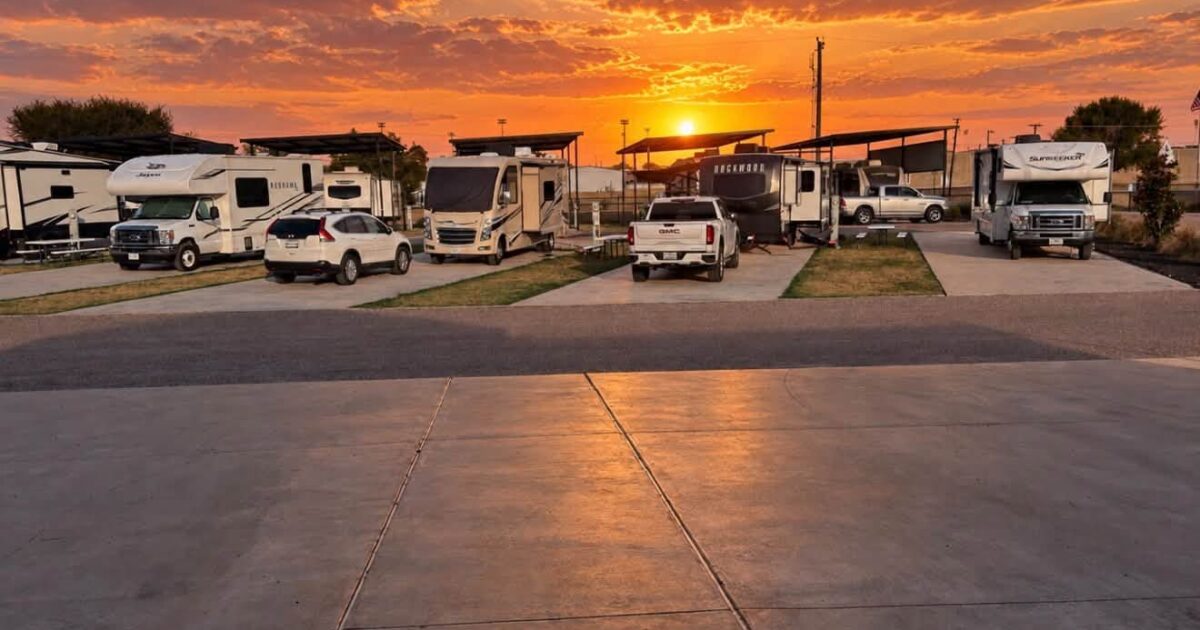
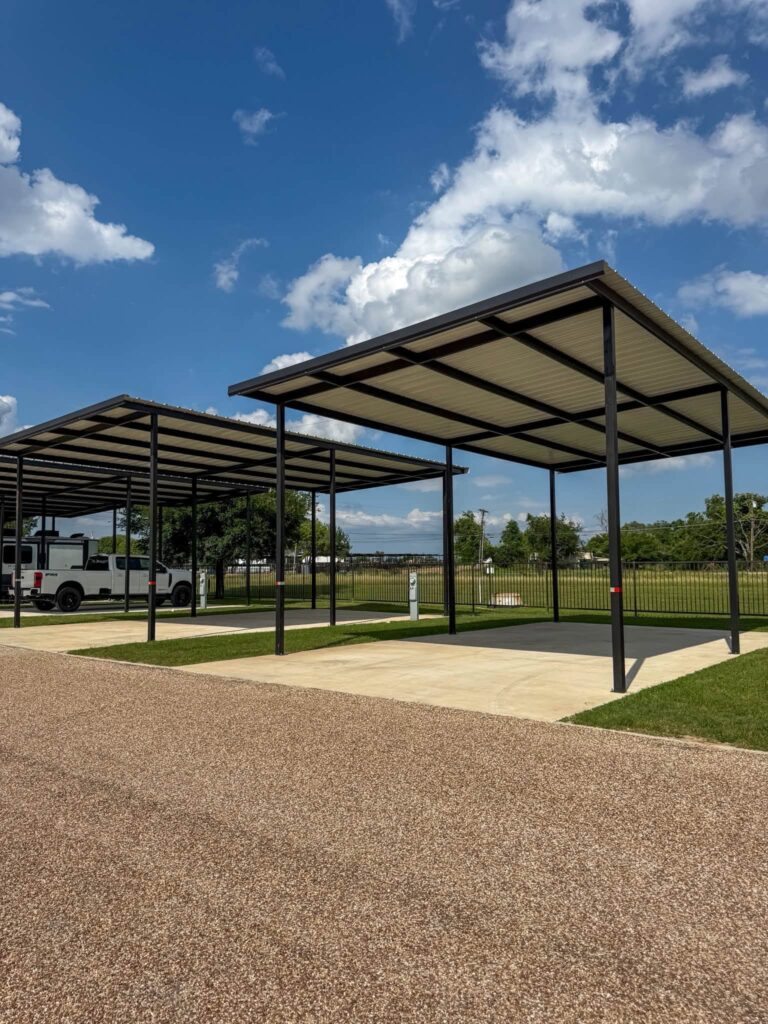
Our park is on New Dallas Highway in Waco. We have tiled private shower rooms, a guest laundry and propane fills on site, and more than 100 of our 255 sites are covered, which helps when a fall storm brings hail or a downpour. The office is open every day from 9 a.m. to 5 p.m., so call ahead if you’ll pull in later.
If you drive a big coach, our Class A motorhome guide covers what to ask before booking anywhere on your route.

If you can spare a second night, Waco is an easy place to spend a day off the road. The Waco Mammoth National Monument, the Dr Pepper Museum and the Texas Ranger Hall of Fame and Museum are each about a 15-minute drive from the park, and Magnolia Market at the Silos is in town too. Our list of things to do near the park has more ideas.
Traveling with a dog? We have a dog park on site, and our pet guidelines are worth reading before you book.
Check the road before you roll
Whatever route you choose, look at TxDOT’s DriveTexas map the night before and again in the morning. It shows closures, construction, weather impacts, rest areas and live traffic cameras.
Frequently asked questions
How long does it take to drive across Texas on I-10?
About 880 miles from Orange to El Paso. A car can do it in two long days, but most RVers take three to four, and five if they want short days and daylight arrivals.
Is I-10 or I-20 better for RVs in winter?
I-10 is usually the safer bet in winter because it stays farther south and sees less ice, especially east of San Antonio. I-20 can be the better choice in good weather if you’re coming from the Deep South, since it’s shorter and avoids Houston.
Where is a good halfway point to stop when crossing Texas?
On I-10, San Antonio or Kerrville is close to halfway. On I-20, Abilene is a common stop. If you’re moving between the two routes on I-35, Waco sits right in the middle of the state.
Is Waco on the way from Florida to California?
Not if you stay on I-10. That route runs through Houston and San Antonio, well south of Waco. Waco only makes sense if you’re coming through Dallas or want to spend time in Central Texas.
Stop with us on your way across Texas
If your route brings you through Central Texas, we’d be glad to have you for a night or a few. Tell us your rig length, how many pets you have and when you expect to arrive, and we’ll help you find a site that fits.
Call 254-799-3105 or send us a message. Safe travels across the big state.